Bring your own lead¶
Repo references: CARSSCenter/OpenNerve-Implantable-Pulse-Generator (header/enclosure) and CARSSCenter/OpenNerve-Standard-Leads (mating lead geometry)
You are not limited to OpenNerve's own Standard Leads and Sub-mm Parylene Cuff. A number of third-party leads have been used with OpenNerve IPGs and dev boards. There are two pathways to using third-party leads with the OpenNerve IPG:
On the benchtop — the development board breaks out feedthrough contacts to header pins. Any electrode with a wire can be connected directly, with no connector compatibility question at all. See Getting started.
Implanted — using a third-party lead with the packaged OpenNerve IPG requires it to match the header pitch and diameter of the Bal-Seal connectors used.
The packaged IPG header specification¶
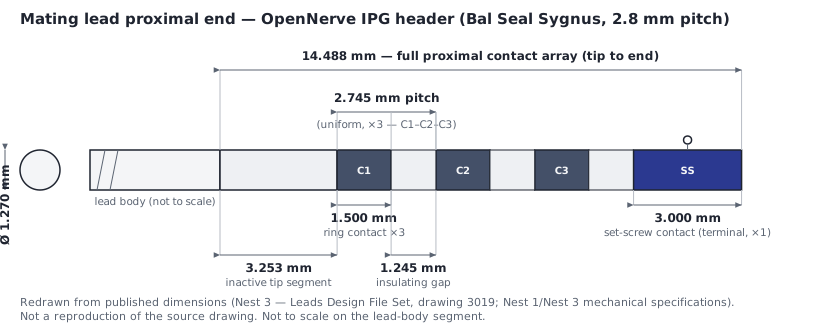
The IPG's lead connector is a Bal Seal Sygnus Neuro system, 2.8 mm pitch, arranged as four bores of four contacts each (16 total; a bore can also be rebuilt as an 8-contact configuration). (source)
A lead's proximal end has to match this geometry to seat correctly:
| Parameter | Value |
|---|---|
| Lead outer diameter | 1.270 ±0.013 mm |
| Contacts per bore | 4 (4 functional ring contacts + 1 terminal set-screw ring) |
| Ring contact length | 1.500 mm each |
| Insulating gap between contacts | 1.245 mm |
| Contact pitch (center-to-center) | 2.745 mm, uniform |
| Set-screw contact length | 3.000 mm (terminal contact) |
| Inactive tip segment | 3.253 mm |
| Full proximal contact array | 14.488 mm, tip to end |
| Retention force | ≥ 10 N (ISO 14708-2 §23.6) |
| Insertion / withdrawal force | ≤ 9.8 N (2.2 lbf) |
| Set screw | #2-56, 316L stainless, 5 in-oz hex torque |
(lead geometry source, drawing 3019; connector materials source)
Unlike in the cardiac space, there is no ISO or AAMI connector standard for neuromodulation leads Bal Seal's Sygnus connector system, which is used in OpenNerve, is engineered per customer: pitch, housing diameter, spring force, and seal design are all specified individually for each device. Two implants both built on Sygnus connectors are not guaranteed to share a mating geometry just because they share a supplier.
Mechanical fit is not electrical fit
1.27–1.3 mm is a common lead diameter across neuromodulation devices, so a lead built for a different header may still physically insert into an OpenNerve bore and hold under the set screw — while its contacts sit in the wrong position relative to the Bal Seal springs. That can bridge two seals, miss a contact band, or make an intermittent connection that looks like a working channel until it isn't. Check impedance on every channel before trusting a non-OpenNerve lead, and don't assume a mechanical fit is a working one.